How the book works
Every skill, the same four steps
From the page of an old book to your kitchen, and back out again. Here is Skill 2.1, Roots in Sand, Onions in the Attic, as the book tells it.
-
1 · The Record
Who wrote it down
“Parsnips should be kept down cellar, covered up in sand, entirely excluded from the air.”
Lydia Maria Child, The American Frugal Housewife, Boston, 1833, p. 33 -
2 · What they did and why
One cellar, several climates
Parsnips went into sand; onions were kept “very dry” upstairs until a hard freeze. The sand held moisture against each root and kept the roots apart, so one soft spot did not spread through the bin.
-
3 · Try It Today
A box of damp sand
A tote of barely damp play sand, carrots or beets layered without touching, a corner that stays cold but never freezes, and a thermometer to decide instead of a guess.
-
4 · What We Leave in the Past
Old kitchen lore
Child also passed on the belief that potatoes “never sprout but three times.” She gives no test of it, and the book marks it Lore.
A page from 1917
Come closer
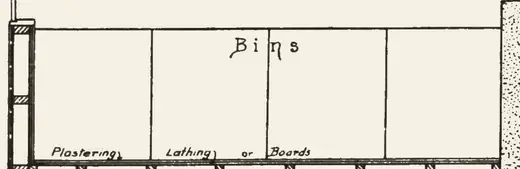
A government plan for a vegetable storage room, printed in USDA Farmers’ Bulletin 879 and reproduced in Chapter 2. Tap a number to see what the book explains.
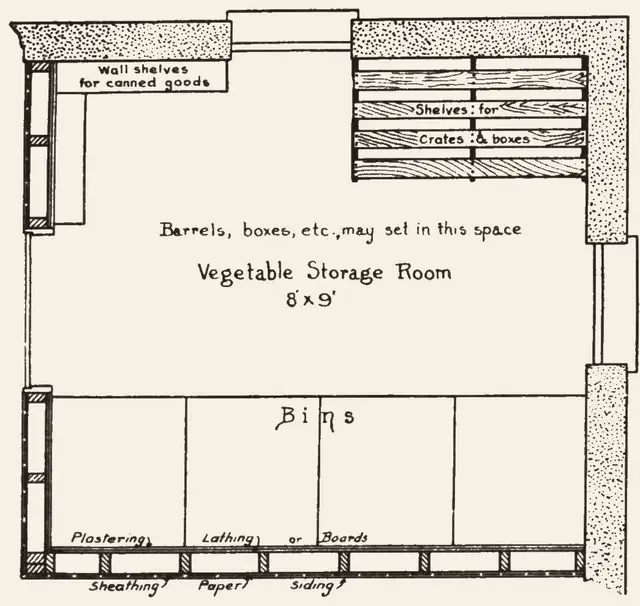
Detail 1 of 5
Crates you can carry out
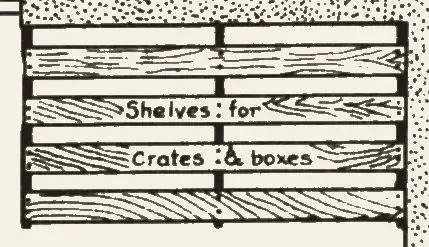
Crates sit on slats, off the ground. The bulletin prefers movable containers to built-in bins, because they can be carried out and cleaned.
USDA Farmers’ Bulletin 879, 1917 · Chapter 2, Skill 2.3
Detail 2 of 5
Shelves to suit the house
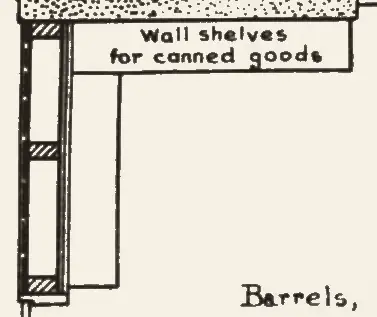
The plan is a sample, not a rule. Its own caption says so: “The arrangement of the shelving and bins may be changed to suit conditions.”
USDA Farmers’ Bulletin 879, 1917, fig. 1 · Chapter 2
Detail 3 of 5
Eight by nine feet, away from the furnace
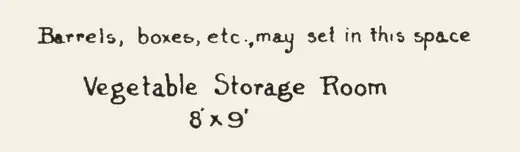
A small room walled off in one corner of the house cellar, with at least one outside window. The reason is the furnace: “Cellars containing a furnace for heating the dwelling usually are too warm and too dry for the storage of root crops.”
USDA Farmers’ Bulletin 879, 1917 · Chapter 2, Skill 2.3
Detail 4 of 5
What a full cellar held
In November 1913, a homesteader in Wyoming listed her own cellar: “one large bin of potatoes (more than two tons), half a ton of carrots, a large bin of beets”, and more than a hundred heads of cabbage.
Elinore Pruitt Stewart, Letters of a Woman Homesteader, 1914, p. 280 · Chapter 2
Detail 5 of 5
A wall against the warmth

The partition walls kept the furnace’s warmth out; the window let cold air in. And underfoot, bare earth beat concrete, “as a certain amount of moisture is desirable.”
USDA Farmers’ Bulletin 879, 1917 · Chapter 2, Skill 2.3
The contents
What’s inside
Eighteen chapters in four parts, from the pantry to the household purse, with an introduction, a closing chapter and six appendices you can print.
Part I
The Pantry by Season
- 1Planning the Year: Almanac and GardenEvery pantry begins with a calendarp. 9
- 2Root Cellars and Cold StorageKeeping the harvest alive until springp. 16
- 3Drying and SmokingSun, air and woodsmoke: the oldest pantryp. 23
- 4Salting, Pickling and the CrockBrine, vinegar and a heavy stonep. 29
- 5Canning: From Appert to the Mason JarA history chapter, with a safety rulep. 35
- 6Bread and Bake DayYeast, a hot oven and a mixed loafp. 41
Part II
Heat, Light & the House
- 7Keeping Warm Without Central HeatWood, ashes and a fire that was never left alonep. 47
- 8Light After Dark: Candles and LampsTallow, wicks and the evening choresp. 53
- 9Wash Day and SoapAshes, kettles, lines and a day set asidep. 59
- 10Cleaning Without Store-Bought ProductsSand, a stiff brush and a day for every roomp. 66
Part III
Make Do & Mend
- 11Darning, Patching, QuiltingOdd minutes, scraps and a basket that was never emptyp. 72
- 12Remaking ClothesTurned seams, changed sleeves and the second life of clothp. 79
- 13Caring for and Sharpening ToolsA whetstone in the kit and a dry place on the shelfp. 84
- 14Baskets, Brooms and RopeA broom on a hook, a basket that was washed, and the lariat on the trailp. 89
Part IV
Hard-Times Economy
- 15The Household Account BookThree columns, a diary that counts, and what a dollar boughtp. 95
- 16Stretching Food: Using EverythingBrewis, hash, meatless Tuesdays and the second day’s dinnerp. 102
- 17Bees, Barn Raisings and NeighborsWork that went faster when the neighbors camep. 109
- 18Teaching Children the WorkWhat the books asked of the young, and what we ask todayp. 116
And around them
Front and back of the book
- Introduction: How to Read This BookRecords, reconstructions and what we left outp. 5
- Closing: What Hasn’t ChangedForty-six skills and a few plain habitsp. 122
- ASeasonal Calendarp. 126
- BSkills Checklistp. 128
- CConverting Period Pricesp. 130
- DGlossaryp. 133
- ESourcesp. 136
- FCreditsp. 138
7-day money-back guarantee
Inside the book
Flip through a few pages
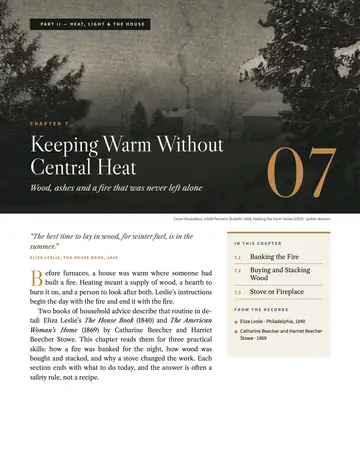
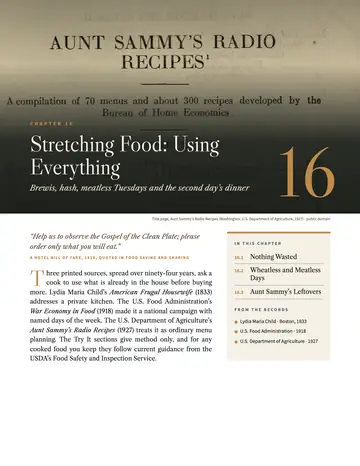
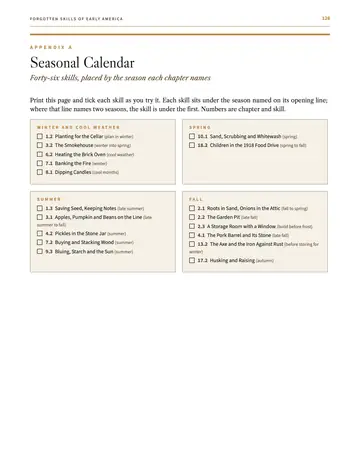
Six pages exactly as you will receive them: US Letter, laid out like a magazine, easy to read on a screen and ready to print.
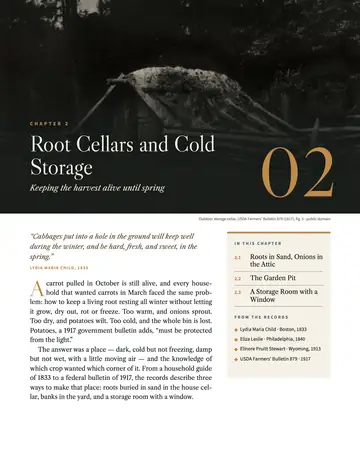
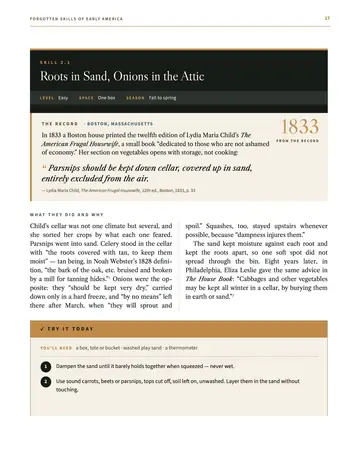
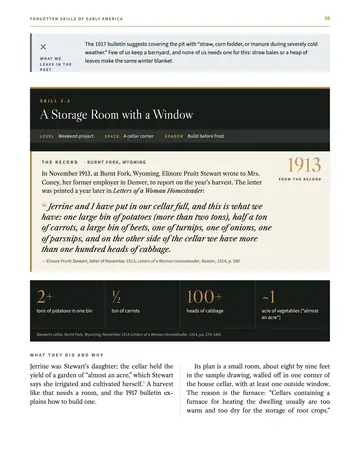
Swipe →
Who speaks in this book
Real records, not nostalgia
Every quotation was read in the original edition and is given in that edition’s spelling, with the page number in the chapter notes. When a source is silent, the book says so.
- 1785–1812Martha BallardHer Maine diary, as printed by Charles E. Nash in 1904
“I have made 28 doz. dipt candles”
- 1833Lydia Maria ChildThe American Frugal Housewife, Boston
“Dedicated to those who are not ashamed of economy.”
- 1840Eliza LeslieThe House Book and Directions for Cookery, Philadelphia
“a barrel of salt fish placed in the cellar will frequently pervade the whole house with its odour”
- 1840 · 1842Robert B. ThomasThe Farmer’s Almanack, Boston
“Dig on, Spuddle, and go ahead in this work”
- 1846 · 1847Catharine BeecherDomestic Receipt Book and A Treatise on Domestic Economy
“Let a woman keep an account of all she spends, for herself and her family, for a year”
- 1859Randolph B. MarcyThe Prairie Traveler, New York
“Two lariats will be needed for every horse and mule”
- 1869Catharine Beecher and Harriet Beecher StoweThe American Woman’s Home, New York
“A cord of wood should be equivalent to a pile eight feet long, four feet wide and four feet high”
- 1914Elinore Pruitt StewartLetters of a Woman Homesteader, from Wyoming
“strength and knowledge come with doing”
- 1918Food Saving and SharingA 1918 schoolbook for the wartime food drive
“My Tuesdays are wheatless, / My Wednesdays are meatless”
- 1903–1939U.S. Department of AgricultureFarmers’ Bulletins, circulars and Aunt Sammy’s Radio Recipes (1927)
“Show this bulletin to a neighbor.”
What we left out, on purpose
- Sickroom advice. The old household books also tell readers how to treat the sick. The book uses none of it and makes no claims about the body or its care.
- Canning methods. The history of canning is here; the method is not. For any home canning, the book sends you to the tested guidance of the USDA and the National Center for Home Food Preservation.
- Dangerous recipes. Lye, quicklime, saltpeter and meat-curing quantities appear as history only, with no amounts and no steps.
And an honest limit: thirty of the forty-six Records are tied to Boston, Philadelphia or New York. The sources say little about the South, or about Black, Native and immigrant households, and the book says so instead of filling the gap with invented scenes.
Before you buy
Questions
How do I get the book?
It is a PDF ebook. As soon as your payment is confirmed, you receive an email with access to the file, which you can download right away.
Can I read it on my phone, or print it?
Both. It opens on any phone, tablet or computer that reads PDFs. The pages are US Letter size, so they print at home on ordinary paper, and the seasonal calendar and the checklist are made to be printed.
I’ve never done any of this. Is it for me?
Yes. Each Try It Today is a small, modern version of the old skill, with a short list of what you’ll need, and it follows current guidance wherever safety matters. Many start with one box, one jar or one sock.
How many pages is it?
138 pages: an introduction, 18 chapters in four parts with 46 skills, a closing chapter and six appendices (a seasonal calendar, a skills checklist, converting period prices, a glossary of old words, the sources and the credits).
Is this a homesteading or prepper manual?
No. It is a history book you can use. There are no survival plans and no canning recipes, and nothing in it promises to save you money. It shows how ordinary households did the work, from their own records, and how to try a safe, small version today.
What if it isn’t for me?
You have a 7-day money-back guarantee: if the book is not what you hoped, ask for a refund within 7 days of your purchase.
Who publishes this book?
Bygone America Press. The book is signed by the press, not by a persona; the voices in it are those of the people who kept the records.

Forgotten Skills of Early America
Take the work seriously, and pass it on
Forty-six skills from the people who did the work, each with a safe way to try it today.
7-day money-back guarantee